Screens captured from the Nina app on 2026/11/04 (Traditional Chinese interface). Your own view may differ by account state and app version. Political and election-related event titles have been masked.
Whales are picked out by the size of their money. Smart money is picked out by track record. One tells you where the money is going, the other tells you who has been right over time — and they are often not the same people. Keeping the two signals apart is what stops you reading "someone bet a lot" as "this side is more likely correct."
This guide uses a live Polymarket market, "The Fed's decision in December?", to walk through Nina's money-flow pages in four steps: where to find whales and smart money, how to read each card, and why net selling is worth watching.
▶ Download Nina and follow along (iOS / Android)
Key points
- Whales = big money: what the largest wallets are buying and selling right now.
- Smart money = good record: what traders who have often been right are buying.
- Read them separately: when they agree the signal is more consistent; when they disagree, that is where the research is.
- Watch net selling too: large traders stepping out often flags risk earlier than their buying does.
- Money flow is not a trade instruction: it helps you decide which events deserve your time, not what to buy or sell.
What is a whale?
A whale is a trader whose single or cumulative trade size is unusually large. The term started in crypto, describing wallets that hold enough to move the price on their own. On prediction markets like Polymarket, trades settle on-chain and are public, so you can see who placed the large bets.
The value of watching whales is knowing where the big money is going. But size only signals conviction, not correctness: whales get it wrong too, and a large position may simply be hedging something else.
What is smart money?
Smart money refers to traders with a strong historical track record — people whose past calls have often landed on the right side. The filter is past results, not bet size.
Smart money positions are usually smaller than whale positions. Their value is in showing which side the people who have read these markets well are on. A good record still does not guarantee this particular call is right.
Whales vs smart money: the difference in one table
| Whales | Smart Money | |
|---|---|---|
| Selected by | Size of capital | Historical track record |
| Question it answers | Where is the money going? | Who has been right over time? |
| What you see | What the largest wallets are buying and selling now | What traders with good records have bought |
| Typical size | Larger | Smaller |
| What to watch for | Large ≠ correct; may be a hedge | Right before ≠ right now |
How to read whale and smart money activity (4 steps)
The walkthrough below uses the Nina app, which sorts large prediction-market trades into two lists — whales and smart money — and tags them.
Step 1 | From the Prediction tab, open money flow
Path: bottom "Explore" → "Prediction" tab at the top → tap any of the "Whales", "Smart Money" or "Expiring" cells on the summary card.
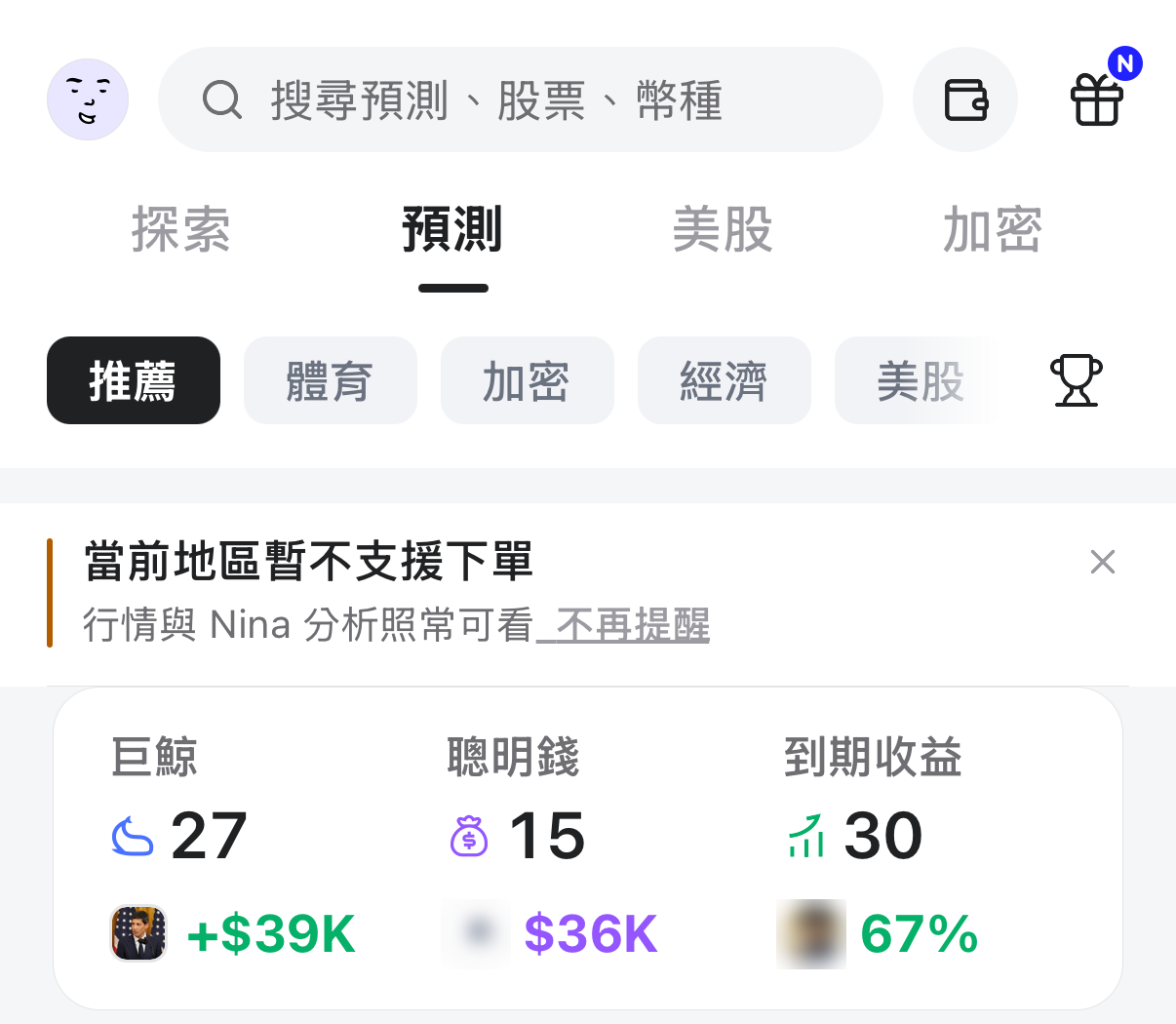
Prediction tab: the summary card below the category row (Whales 27 | Smart Money 15 | Expiring 30) is the way into money flow
- Whales 27: 27 entries in the whale list right now, with one of them previewed below (net buying +$39K).
- Smart Money 15: 15 entries in the smart money list.
- Expiring 30: events settling soon — not covered here.
Once inside, the tabs at the top switch between the three lists.
Step 2 | Whales: which side the big money is on
The whale list groups together events that have recently seen large flows. Each card needs only four readings:
- Which event: the card title.
- Which side: for example "No change · No" means the No side of the "no change" outcome.
- How much net buying: buys minus sells; green is net buying.
- Current price: what that outcome costs now. 0.765 is roughly a 76.5% implied probability.
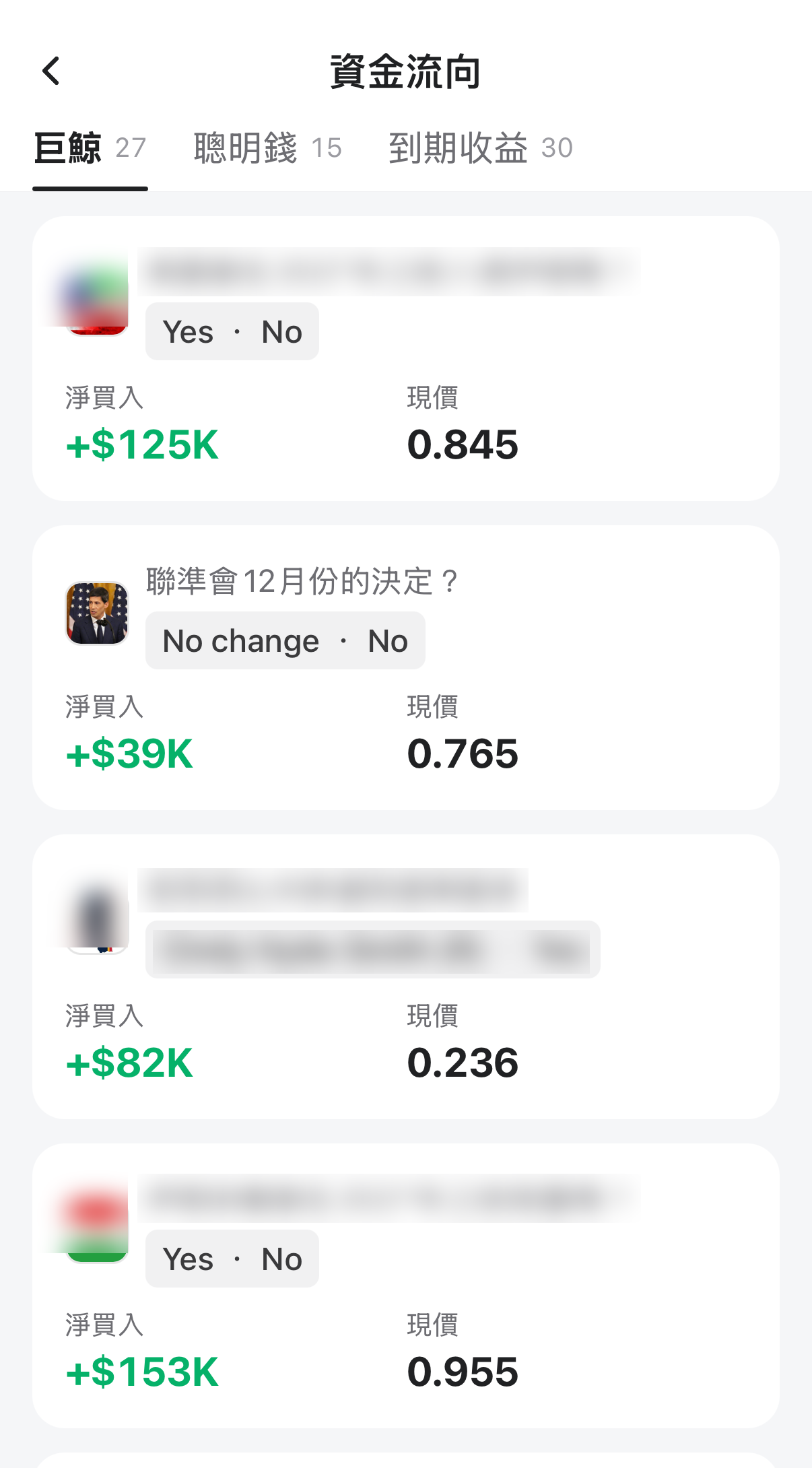
The whale list (political and election-related event titles masked)
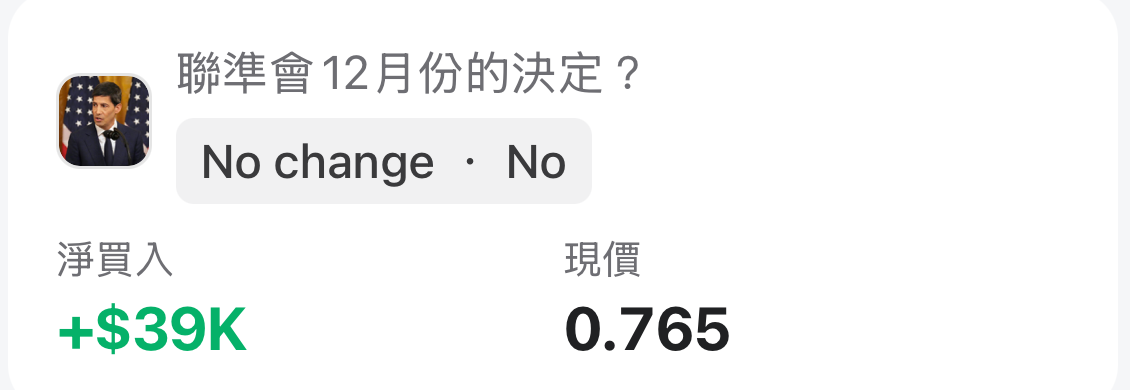
Example: "The Fed's decision in December?" No change · No, net buying +$39K, price 0.765
In plain terms: whales net bought about $39,000 on the side that says the Fed will not leave rates unchanged in December, and that side currently prices at 0.765.
Step 3 | Smart money: what the good records are doing
Switch to the "Smart Money" tab. The cards read the same way — event, side, size, price. The difference is the filter is track record, and the amounts are usually smaller.
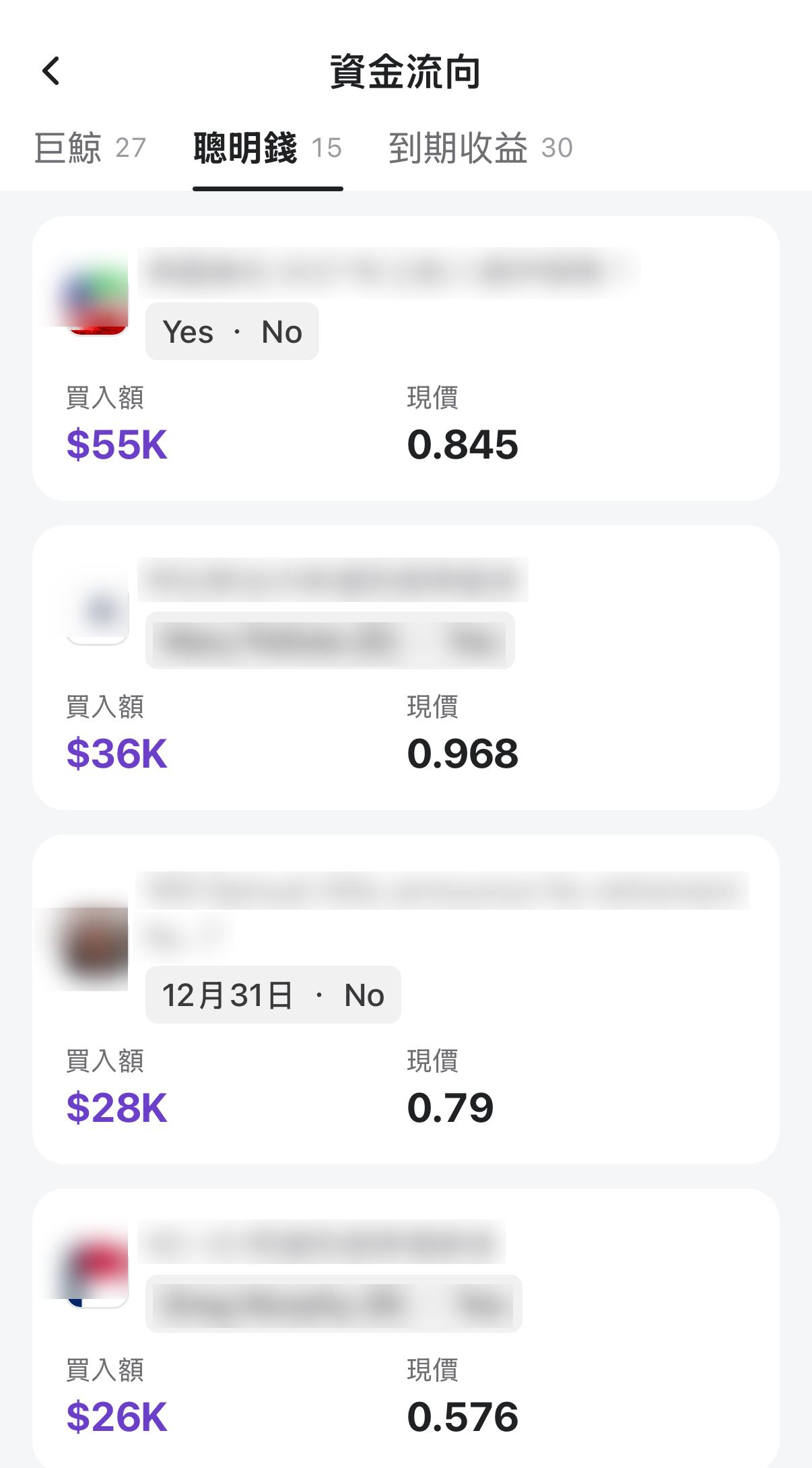
The smart money list (political and election-related event titles masked)
Inside an event's trade log, the two groups carry different tags, so you can tell at a glance who is moving:

"Whale" tag: ratehikes bought No @0.76, +$69K

"Smart Money" tag: 0xa751… sold Yes @0.24, −$2K
To find traders worth following over the longer term, open the leaderboard behind the trophy icon at the top right of the Prediction tab.
Step 4 | Open the event and read flow by outcome
The lists only tell you which events large traders are active in. For the full picture, open the event and switch to the "Money Flow" tab.
Path: tap any event → the row at the top of the event page ("Nina Analysis | Event Details | Money Flow | Resolution Rules") → choose "Money Flow".
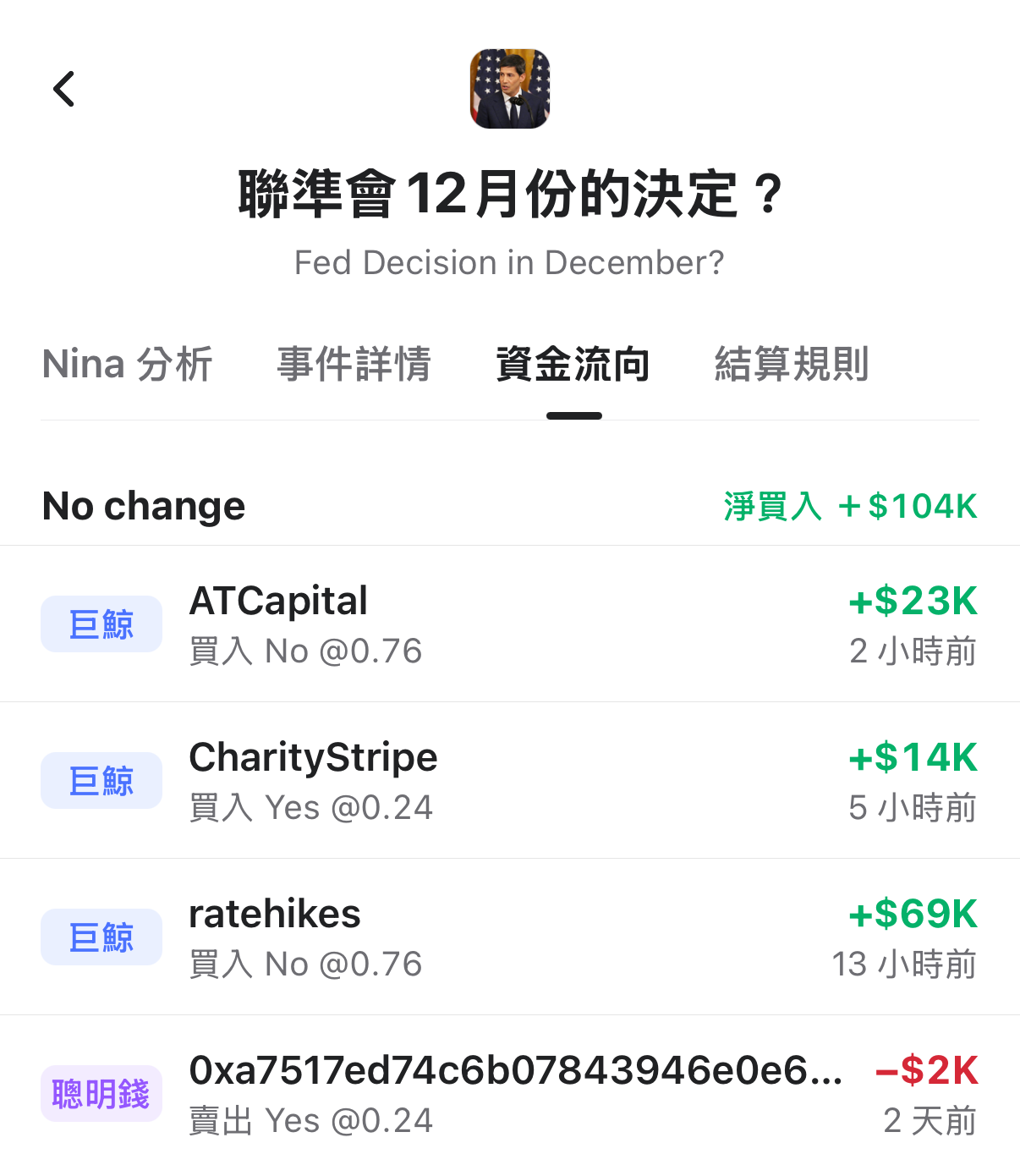
"The Fed's decision in December?" money flow: the No change outcome with net buying of +$104K
This page groups by outcome. Each row tells you:
- Who: the account name, with a "Whale" or "Smart Money" tag.
- What they did: bought or sold, which side, at what price (for example "bought No @0.76").
- How much and how long ago: the amount and timestamp on the right (for example +$69K, 13 hours ago).
In this market, the "No change" outcome shows buys from whales ATCapital, CharityStripe and ratehikes, alongside a sale from one smart money account. Who bought, who sold, at what price, how many hours ago — all in one view.
What does it mean when whales sell? Reading net selling
Most people only look at what large traders bought. But large traders stepping out often flags risk earlier than their buying does.
In the same market, whales were also selling:
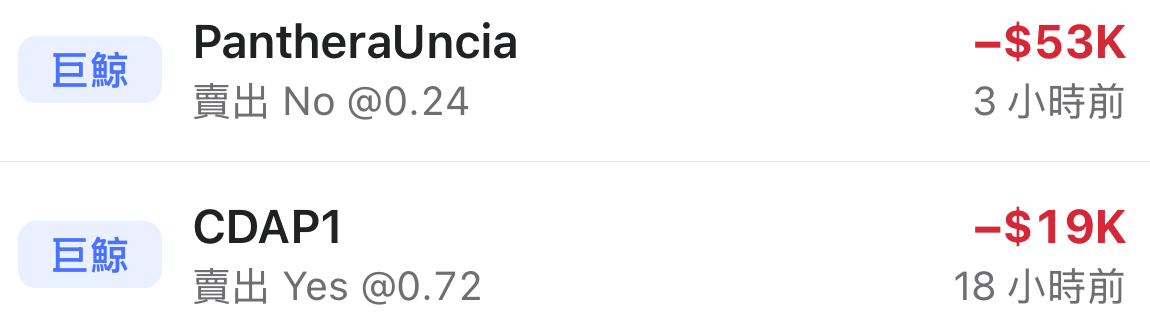
PantheraUncia sold −$53K (3 hours ago), CDAP1 sold −$19K (18 hours ago)
When you see net selling, keep three things in mind:
- Selling means someone is stepping out or trimming a position.
- Stepping out often flags risk earlier than buying does: when someone grows uneasy, it usually shows up in sales first.
- But there are many reasons to sell: taking profit, rotating, or hedging something else. Read it alongside the change in probability, and don't draw conclusions from a single trade.
Can you just follow whales or smart money?
Copying trades directly is not advisable. Three reasons:
- By the time you see it, the price has often moved. The market reacts to a large order, so your fill is usually worse than theirs.
- You cannot see their whole position. A single buy may be hedging another event, and reading it alone can point you the wrong way.
- Neither size nor a good record guarantees this call is right.
A better use is to treat money flow as a starting point for research. When you open the money-flow page, ask three questions in order:
- Which side is the big money on? Look at whale net buying and net selling.
- Which side are the good records on? Check whether smart money agrees with the whales.
- Is it already in the price? Compare the current price and the change in probability to judge whether the market has absorbed these moves.
When both lists sit on the same side, the signal is more consistent. When they split, that is where the work is.
▶ Open Nina's Prediction tab and see where large traders are now
Further reading:
- Get started with Nina in 5 minutes: from finding an opportunity to posting a Sentinel: first time using Nina? The full path from exploring to posting a Sentinel.
- How Polymarket odds work: a five-step check for whether an edge is real: converting a quote into a probability, using the best ask for real cost, and ruling out thin books and news already priced in.
FAQ
What is the difference between whales and smart money?
Whales are filtered by capital size and show where the money is going. Smart money is filtered by historical track record and shows who has been right over time. Some traders are both, but most of the time they are two different groups.
What does "smart money" mean?
Traders with a high historical hit rate and a strong long-term record. The filter is past results rather than bet size, so individual positions are often smaller than whale positions.
Will I make money by following whales?
No. A large position only signals conviction. Whales get it wrong, and they may be hedging another position; by the time you see the trade, the price has usually moved. Money flow is a starting point for research, not a trade instruction.
What does "net buying" mean?
Buys minus sells over the same period. Positive net buying means more was bought than sold in that window; negative means net selling.
How do I read "bought No @0.76"?
It means buying the "No" side at a price of 0.76. Prediction market prices run between 0 and 1 and can broadly be read as the market's implied probability, so 0.76 is roughly 76%.
Does whale selling mean the event will not happen?
Not necessarily. Selling can be profit-taking, rotation or hedging. What carries more weight is a pattern — several whales net selling while the probability falls at the same time — rather than one trade.
Can I trade prediction markets in every region?
Prediction markets cannot be traded in some regions, and the app will show that ordering is unavailable there. Prices, money flow and Nina's analysis remain fully viewable.
Money flow reflects trades as they happen and does not indicate future results. Nina is an information tool, not a licensed adviser, and nothing here constitutes investment advice. Prediction markets cannot be traded in some regions; please follow your local regulations. Screens captured from the Nina app on 2026/11/04, with political and election-related event titles masked.
Nina is the Web3-native AI agent from Antalpha (NASDAQ: ANTA), covering crypto, prediction markets and US stocks: conclusion-first analysis with named sources and freshness badges, and Sentinel mode for round-the-clock monitoring. Vibe Trading, Nina's AI trading bot, turns a one-sentence trading idea into a rule-based bot that you backtest on historical data and then run in paper trading; live trading for Vibe Trading is not yet available. Backtest results are simulated on historical data and do not indicate future returns. Trades in the Nina app are signed by you in your own wallet by default (Verification-free ordering for Polymarket and perpetuals, which you turn on yourself, are signed by a key you authorized); Nina never holds your funds and takes no cut of principal or profits; a transparent routing fee applies on the execution path. Nothing here is investment advice or a price prediction. Official channels: antalpha.com, the Nina app on the App Store and Google Play, x.com/antalpha_ai.