On Monday, October 26, the NBA named Kalshi and Polymarket its Preferred Prediction Market Exchanges. The deal settles who decides which NBA markets can exist and whose data settles them. The prices on the screen still need the same careful reading they did last week.
So we pulled them. At 03:15 UTC on October 29 we downloaded five NBA futures markets from Polymarket's public API: the 2027 title market, both conference markets, MVP and Rookie of the Year. The title market alone has traded $33.3 million. Read with care, it gives you a live probability for all 30 teams. Read the way most people scroll it, it's a board that adds up to more than 100%, a team whose two prices contradict each other, and a page of players listed at 50% that nobody has ever traded. Below is what we found, and the four checks we'd run on any NBA price before trusting it. Nothing here is a recommendation to buy or sell any contract.
What the deal changes
According to the Associated Press and NBC Sports, the league gets three things it didn't have with prediction markets before.
It gets a say over the menu. The NBA can now approve which types of NBA markets the two exchanges offer. Earlier this month it told its sportsbook partners to drop bets like which player records the first stat, the opening tip, and the under on players expected to see only a few minutes, and the prediction-market deals are expected to carry similar limits.
The exchanges, in turn, get official data. Kalshi and Polymarket receive NBA statistics from the league's partner Sportradar to run and settle authorized markets, along with the right to use league logos and the title Preferred Prediction Market Exchange of the NBA.
And there are integrity rules. League and team personnel can't trade NBA event contracts, and both exchanges have to share information on suspicious trading and investigations. The NBA also signed a memorandum of understanding with the Commodity Futures Trading Commission, the federal regulator for prediction markets.
The backdrop is last year's arrests of Terry Rozier, Chauncey Billups and Damon Jones on allegations involving inside information. Jones has pleaded guilty; the other cases are ongoing.
Legality is a separate question, and the deal leaves it open. AP reports that more than a dozen US states are in litigation over prediction markets, and the NFL asked the Supreme Court this month to rule on who regulates them. Whether you can trade these contracts still depends on where you are.
How to read NBA championship odds on Polymarket
Start with the ask
Each team in the champion market is its own YES/NO contract that pays $1 if that team wins the 2027 title. A price of 21.5 cents means the market puts the chance near 21.5%. Here are the top eight in our snapshot:
| Team | Midpoint | Best bid | Best ask | Traded |
|---|---|---|---|---|
| San Antonio Spurs | 21.5% | 21.0¢ | 22.0¢ | $1.01M |
| Oklahoma City Thunder | 17.5% | 17.0¢ | 18.0¢ | $1.15M |
| Philadelphia 76ers | 10.2% | 10.2¢ | 10.3¢ | $1.74M |
| Houston Rockets | 8.0% | 7.9¢ | 8.0¢ | $1.35M |
| Boston Celtics | 6.5% | 6.0¢ | 7.0¢ | $1.03M |
| New York Knicks | 6.5% | 6.0¢ | 7.0¢ | $1.04M |
| Minnesota Timberwolves | 5.1% | 5.1¢ | 5.2¢ | $1.14M |
| Detroit Pistons | 4.3% | 4.3¢ | 4.4¢ | $1.17M |
The headline number is the midpoint. Anyone buying pays the ask. On the Spurs the gap is a full cent; on the 76ers and Rockets it's a tenth of a cent. A one-cent spread on a 21-cent contract is almost 5% of the price, which is enough to matter if you're comparing it with a sportsbook line or your own estimate.
Add up the board
Only one team can win, so the 30 probabilities should sum to 100%. They don't. The midpoints come to 103.5%. The best asks come to 107.3%, so buying YES on every team at the current offer would cost $1.073 to collect exactly $1. The best bids come to 99.7%.
Those extra 3.5 to 7.3 points are the book's overround, the same margin a sportsbook builds into its odds. Divide any single price by the board total before you treat it as the market's view. The Spurs at 21.5% on a 103.5% board are closer to 20.8%. The adjustment is small for the favorites and, in relative terms, large for the teams trading at a cent or two.
Test one market against another
Polymarket also lists conference champion markets. A team has to win its conference before it can win the title, so the title price should never sit above the conference price. Divide one by the other and you get the market's implied chance that the team wins the Finals once it's there. We ran that division for the top six teams in each conference.
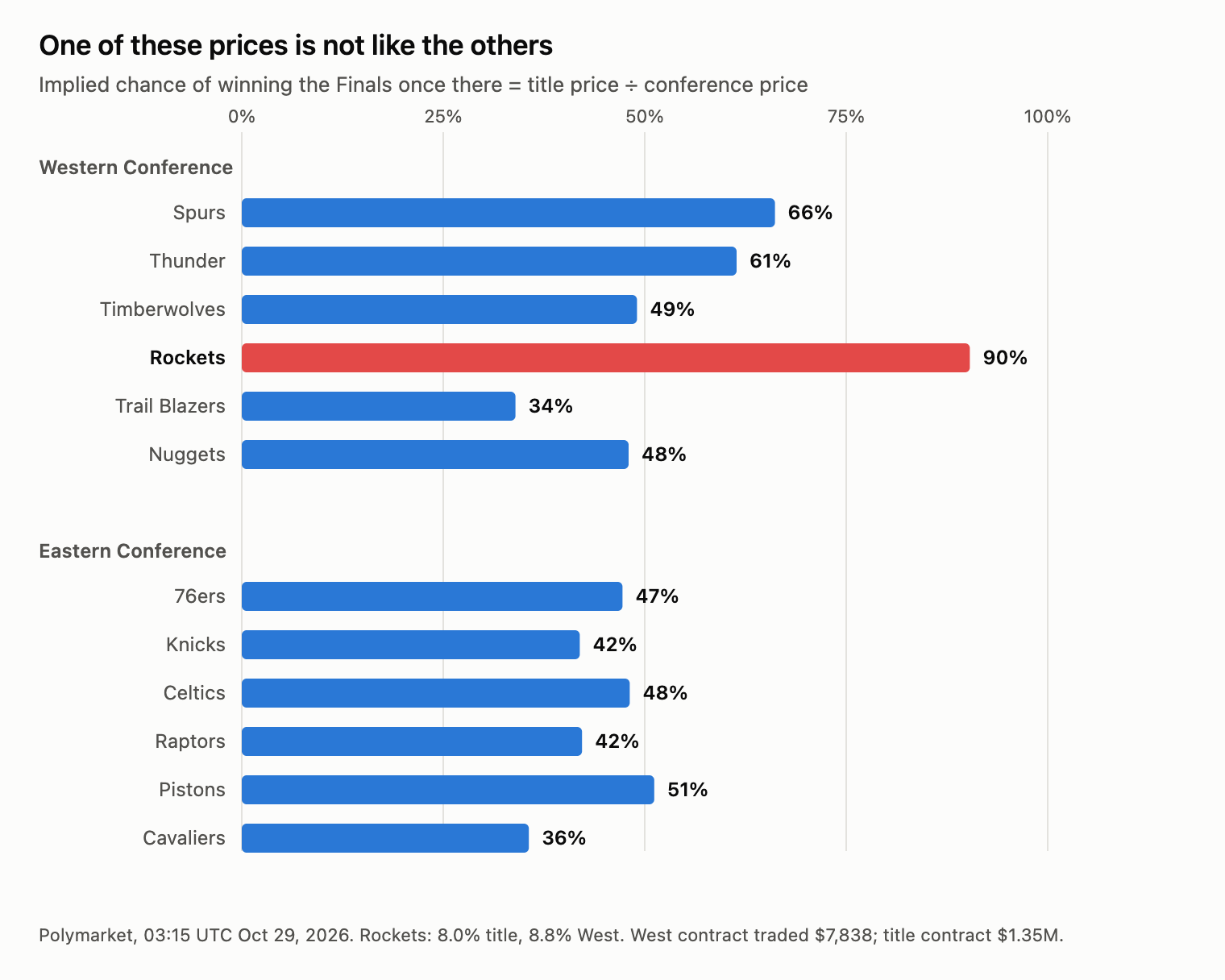
Eleven of the twelve land somewhere sensible, between 34% and 66%. The Spurs come out at 66%, the Thunder at 61%, the 76ers at 47%. The Rockets came out at 90%: 8.0% to win the title, 8.8% to win the West. Taken at face value, the market thinks Houston would beat any Eastern champion nine times out of ten, while it rates every Eastern contender as a coin flip or worse against everyone else. That's hard to believe.
The two prices can't both be right, and volume suggests which one to look at first. The Rockets title contract has traded $1.35 million. The Rockets West contract has traded $7,838, and the entire West market $195,000, next to $33.3 million on the title. A thin market's last price can sit for days while the deep one keeps moving. Before calling this a mispricing, we'd look at how much is actually resting at that West price and when it last traded. A price with very little money behind it says very little about the probability, and the gap is not a reason to trade.
These prices will have moved by the time you read this, and the gap may be gone. The division still works on any pair of linked markets.
MVP and award odds: throw out the 50% rows
The 2026-27 MVP market lists 60 names. Twenty-six are placeholders labeled Player A, Player B and so on, each shown at 50% with no bid, no offer and no trades. That 50% is the midpoint of an empty order book. Leave those rows out before you add anything up: left in, they push the MVP board past 1,400%.
They're easy to miss. Our own first filter matched single letters, so "Player AA" and its neighbors in the Rookie of the Year market slipped through. We only caught them when they showed up in our output at 50%.
Among the 34 real MVP names, Victor Wembanyama leads at 28.5%, then Luka Doncic at 21.1%, Shai Gilgeous-Alexander at 19.5% and Nikola Jokic at 10.0%. The market has traded $129,105 in total and has $458,257 sitting in resting orders, so most of what you see is quotes. Its best asks add to 116.0%.
Rookie of the Year is thinner at the top. Yaxel Lendeborg shows at 30.1%, but the best bid is 26.4 cents and the best ask 33.8. With a 7.4-cent spread, the market's real view could be anywhere in that band. On early-season award markets we read the spread first and the midpoint second.
Read the rules
Every Polymarket market carries resolution text, and you're buying it along with the price. The title market resolves YES for the team declared NBA champion for 2026-27. If the season is cancelled, or no champion is declared by 11:59 PM ET on June 30, 2027, it resolves to Other. The named source is official NBA information, though the rules add that a consensus of credible reporting may also be used.
It's step four in our five-step check for Polymarket edges: before you call a price wrong, make sure you and the market are betting on the same event. With Sportradar data now settling authorized NBA markets, resolution should get cleaner for game and stat contracts. The league's approval right also means some contract types you see today may disappear.
Where Nina fits
Nina reads prediction markets the way we did here. Ask about an NBA market and it returns the price, the order book and the spread, with a source and timestamp on each figure. Put a team's title contract and its conference contract on a Sentinel watch and you'll get an alert when either moves, with the news behind the move, so you can redo the division yourself instead of refreshing two pages.
Nina is non-custodial. If you place a Polymarket order through the app, Nina drafts it and you sign it in your own wallet. Depending on local regulation, ordering may be unavailable in your region; market data and analysis remain available. Nina won't tell you which team will win.
Frequently asked questions
What did the NBA announce with Kalshi and Polymarket?
On October 26, 2026, the NBA named Kalshi and Polymarket its Preferred Prediction Market Exchanges in multi-year deals. The league can approve which NBA market types they offer. The exchanges receive official NBA data through Sportradar to run and settle markets. League and team personnel can't trade NBA contracts, and the exchanges share information on suspicious trading. The NBA also signed a memorandum of understanding with the CFTC.
Why do NBA championship odds on Polymarket add up to more than 100%?
Each team is a separate contract, and every price carries a spread between buyers and sellers. On October 29, 2026 the 30 midpoints in the 2027 champion market added to 103.5% and the best asks to 107.3%. The excess is the overround. Divide each price by the total for a cleaner probability.
How do NBA odds on Polymarket work?
A YES price in cents is the market's probability in percent: 21.5 cents means about 21.5%. For a more accurate number, use the ask, which is what a buyer actually pays, and divide by the sum of all outcomes in that market to remove the overround.
Why can the conference odds and the title odds disagree?
They're separate markets with separate traders and very different depth. On October 29, 2026 Polymarket priced the Houston Rockets at 8.0% for the title and 8.8% for the West, which implies a 90% chance of winning the Finals. The West contract had traded under $8,000 against $1.35 million for the title contract, so the thinner price is the first one to question.
What does it mean when a player is listed at 50% with no trades?
It's a placeholder contract with an empty order book. Polymarket shows the midpoint of a zero bid and a $1 ask, which comes out to 50%. The number carries no information, so leave it out.
Does the NBA deal make prediction markets legal everywhere?
No. The deal covers the league's relationship with two exchanges and the CFTC. More than a dozen US states are in litigation over prediction markets, and availability outside the US depends on local law. Polymarket and Kalshi each restrict some jurisdictions.
Nina is the Web3-native AI agent from Antalpha (NASDAQ: ANTA), covering crypto, prediction markets and US stocks: conclusion-first analysis with named sources and freshness badges, and Sentinel mode for continuous monitoring. Self-custodial. Never holds funds, never trades for the user, takes no cut of principal or profits; a transparent routing fee applies on the execution path. Nothing here is investment advice or a price prediction. Official channels: antalpha.com, the Nina app on the App Store and Google Play, x.com/antalpha_ai.
Related reading: Most Polymarket "edges" are not real: the five-step check for 2026.